• About

Peaces of My Heart

~ Life gives you the pieces; it's up to you to make the quilt. In the end, "It's ALL about love…"

Peaces of My Heart

Monthly Archives: March 2015

Selma at 50. O M G

10 Tuesday Mar 2015

Posted by dawndba in Uncategorized

≈ Leave a comment

Tags

Ambassador Andrew Young, Bloody Sunday, Edmund Pettus Bridge, Jesse Jackson, Martin Luther King, Martin Luther King III, MLK Dream Speech, Rev. Al Sharpton, Selma, Selma 50th commemoration, Selma to Montgomery March, Tom Joyner, Viola Liuzzo

In a previous blog post, I said that I was “Going to Selma” for the 50th anniversary commemoration of the Bloody Sunday March with a former student, Randy Gold who I had gone with 15 years before, in 2000, and his 8-year-old, son Natanel and my 8 year-old granddaughter, Makayla.

As you know, Bloody Sunday is the name given to the events of March 7, 1965, when 600 non-violent protesters began a march from Selma to Montgomery, AL, the state capitol, to protest blacks not being allowed to vote simply because they were black. As they reached the bottom of the Edmund Pettus Bridge in Selma, they were met by state troopers who proceeded to tear gas them, beat them with clubs, fists, and barbed-wire wrapped clubs, and ride over them with horses. Two weeks later after a call was sent out by Dr. Martin Luther King, Jr.  for people of good will to join in the march, 25,000 marched across the bridge with the protection of troops federalized by President Lyndon Baines Johnson. The Voting Rights Act of 1965 was signed into law a few months later by President Johnson.

So, this year is the 50th anniversary of the historical event and we went.

OMG.  I am so glad we did.

Makayla and I drove the hour from Athens to Randy’s in Atlanta, and from there we had the three hour drive to Selma.  It was worth very mile.  Along the way, maybe near Montgomery, we saw a two-bus and one short van convoy with a front and back police escort.  Even though we could not see through the darkened glass of the vehicles to see who it was, we had no doubt where they were headed. We felt even more excitement as we passed by the Viola Liuzzo memorial along the highway.  You may recall that she is the white Detroit mother who responded to the Bloody Sunday violence she saw on TV by coming down to Selma when the call when out to the nation to join them for another attempted march for voting rights.  She was shot to death by the KKK as she ferried marchers to the Montgomery airport.  There is a tombstone memorial on the route between Selma and Montgomery, which is quite noticeable because it is right there on a rise beside the highway and is surrounded by a wrought iron fence to protect it from continually being defaced.  Even though we were driving on the very stretch that the marchers used from Selma to Montgomery 50 years ago, it made it even more real to see her very sad memorial there, and to remind us of why it was important of us to take time out of our busy schedules to be there.

When we got to Selma, we were lucky enough to find a parking space right behind the housing subdivision that sits just across the street from the Brown Chapel AME Church that served as the gathering point for the March 50 years ago and was where people were gathered when we arrived.  We had no real idea of what was what. Online details were pretty sketchy, but it didn’t matter.  We knew that we’d find out when we got there.  If you show up in a town like Selma, AL for something like this, you really don’t have to worry about finding your way or other details.  Everyone is there for the same thing, so information won’t be hard to find.

As it turned out, there was a jumbotron video screen set up outside the church, as it was filled to capacity inside and there were zillions of people outside. That was probably the first really big difference Randy and I noticed from when we had come 15 years ago, to what, I think, may have been the first big commemoration, when President Bill Clinton came in 2000.  That time, we were inside the church.  In fact, I think pretty much anyone who wanted to could come in.  There were lots of people there, but not like this time.

So, we found a spot close to the church and stood by the barricades blocking off the street, watching the speakers as they took their turns at the pulpit in the church.  Rev. Al Sharpton was on when we came.  Then there was Rev. Jesse Jackson.  We saw seated there Martin Luther King, Jr’s son, Martin, III, and former UN Ambassador Andrew Young. As the speaking service ended, we were well placed to see the the attendees as they left.  Radio personality Tom Joyner walked by.  Several of the luminaries got right into their cars with dark windows before we even realized who they were.  We got great pictures of Jesse Jackson working the crowd.

Unlike 2000 when the folks came out of the church and lined up to begin the march, this time, age had become a factor and a lot of the historical figures had to drive to the foot of the Edmund Pettus bridge.  There was also the logistical matter of the crowds.  Not everyone had amassed in front of the church.  As the program was going on, there were also people who skipped that part and went directly to the bridge.  It meant that the streets were not totally clear for cars because the crowds were massive.  We finally fell in and began to walk with the crowds headed toward the bridge.  As we neared it, the crowd grew.  By the time we got to where we could see the bridge, the bridge was a solid mass of people.  It was unbelievable.  It was incredible that that many people had come to show their support for the idea of freedom, justice, and equality.

Where Randy and I had been able to simply walk over the bridge in 2000, though with many others, this time we could barely move. While we easily managed a photo with Ambassador Andrew Young in 2000, it would have been more difficult this time. We inched along, tightly holding on to the hands of our 8-year-olds, lest they be quickly swallowed by the crowd.  However, the mass of people did not take away from the impact and significance of what it was we were doing.  There was still an incredible sense of occasion.  All of these people, many with matching T-shirts from their organizations touting the 50th anniversary and their organization’s support, had taken the time, energy, effort, and expense to come be here in this place at this time to show their respect and honor for those who were brave enough 50 years ago to walk in the very place we were walking, all so that they could help America live up to its promise that “All men are created equal…”

Though they were so much shorter than most of the people in the crowd, and did not know all the famous people who had been such civil rights pioneers (though we told them as we saw them), the children with us understood the import of the occasion.  On the drive home when Randy asked how it made them feel to be a part of this and to walk over the bridge, Makayla said it made her feel famous to know she walked where she had seen the people in the video marching for their rights.

It is not always convenient to be at an event like this.  Most of us go through our lives pretty much just doing what we need to do day to day.  But there are times when you have to step back and look at things from a different perspective.  Sometimes you have to live life with a sense of the history and import of the moment.  As president and CEO of an accounting firm, and an incredibly busy civic activist and father of three, Randy is as busy as a one-arm paper hanger.  As someone in the throes of working and advocating and preparing for an upcoming TED Talk that made me cancel spring break plans, I, too, am busy.  Even Makayla was leaving town the next morning with her Mom and brother for spring break in Florida.  Everyone had perfectly valid reasons not to interrupt the normal flow of their lives by going.  But Randy and I understood not only the historical significance of the event, but also our own personal historical significance since we had been at the commemoration 15 years before.  It also held special significance for me because I had been at the 1963 March on Washington as a 12-year-old, and my life’s work is in dealing with issues of social justice and diversity and inclusion.  We understood that no matter how busy we were, this was important.  Makayla, having had many, many discussions with me about these issues in her 8 short years on earth, was as excited as I was to go.

Sometimes, the significance of the event is as much—or even more—about creating the memory and aftermath as it is about the event itself.  As a 12-year-old at the Lincoln Memorial on August 28, 1963, who was just thinking it was awfully hot, there were more people than I’d ever seen in my life, and trying to figure out what the “SNCC” and “CORE” meant on the paper hats I saw people wearing, I had no idea of the profound effect that the 1963 March would have on me and my life.  Listening to Dr. King’s Dream Speech, I had no clue that 48 years later I would receive my University’s highest award, the MLK, Jr. Fulfilling the Dream Award, for building bridges to understanding.  Even Randy and I having the memory of having gone 15 years before in 2000, at what Randy says was the first official commemoration event, is an incredible memory, especially thinking about all that has happened in our lives in that 15-year span.  But, with his son and my granddaughter, there is no telling what this memory will mean for them and how it will resonate for them in the years to some.  Even if it is just as a pleasant thought, it will be worth it.  They will never again see the footage of what occurred at the Edmund Pettus Bridge that day in 1965 and not be again connected to the memory of walking over that bridge in a sea of humanity with their Dad and Nana.  That is worth what it took to make that happen.
IMG_2550  20002015-03-08 16.09.492015

Going to Selma

07 Saturday Mar 2015

Posted by dawndba in Uncategorized

≈ Leave a comment

Tags

"Glory" the Selma song, "Selma" the movie, Academy Awards, AGHLLC, Bloody Sunday, Civil rights, CNN, Dr. Sanjay Gupta, Drl Martin Luther King, Edmund Pettus Bridge, Jr., Legal Environment of Business, ML4, ML4 Foundation, Selma March 2015, Voting Rights Act of 1965

I’m going to Selma tomorrow (3/8/2015).  This weekend is the 50th anniversary of the Bloody Sunday March from Selma, AL to the state capital in Montgomery.  All the black folks wanted to do was let their state government know that it was not right —not even constitutional—to prohibit them from voting simply because they were black.  The march ended when the 600 or so peaceful marchers who were simply walking along crossed the Edmund Pettus bridge and were met with state troopers who gassed them, beat them, and rode horses over them.  Thank goodness it was all caught on film.  When the scene hit the evening news, or worse, interrupted the prime-time showing of “Judgment at Nuremberg” on television, the country was appalled.  Of course, all of this should sound familiar because it is the basis for the excellent Oprah Winfrey movie, “Selma,” that a few weeks ago won an academy award for its title song, “Glory.” As you know, two weeks later, the march took place once again, only this time, thousands had responded to Dr. Martin Luther King, Jr.’s call to come and offer support.  The state troopers were federalized by President Lyndon B. Johnson and the marchers were able to successfully march to Montgomery.  The Voting Rights Act was signed into law by President Johnson a few months later.

I’m taking my 8-year-old granddaughter.  She is so excited to be able to see some small part of the struggle of the history of black folks that I have been feeding her since the minute she was born.  I love it that she feels that way.  Maybe it skips a generation.  And while I think they now appreciate it, I always had to drag her mother and aunts with me to things like this.  Maybe at some point I’ll have to drag her too.  But, for now, she is just as excited as I am to be going.

President Barack Obama will be in Selma this weekend with his family.  The vice president will be there.  Virtually everyone with any connection to the movie will be there, as will dozens of members of Congress, virtually any civil rights leader of any ilk, and thousands of interested folks from around the world who care about freedom and justice and equality.  Fifty years later, we still need people to care.  These things are not a done deal.  Just because the “colored” and “white” signs are off the water fountains and blacks, by and large can now safely vote, does not mean the issue is over.  Among other things, recent attempts to weaken black voting power through seemingly “objective” measures such as re-districting and voter ID laws, as well as the recent demonstrations over the all-too-frequent killing of unarmed young black men by police and others in some way connected to law enforcement have shown us this.  Our work as a country is not done.

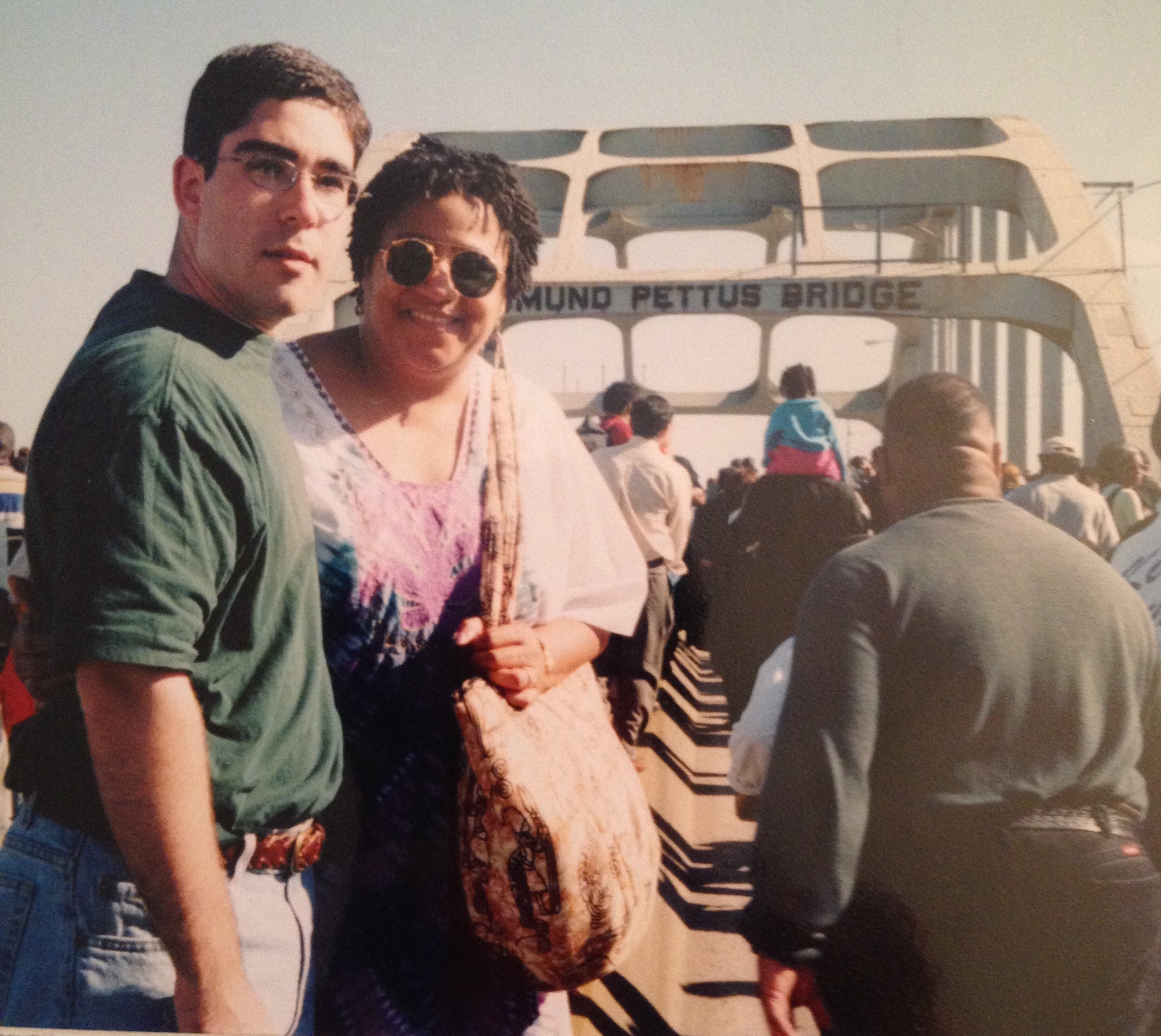
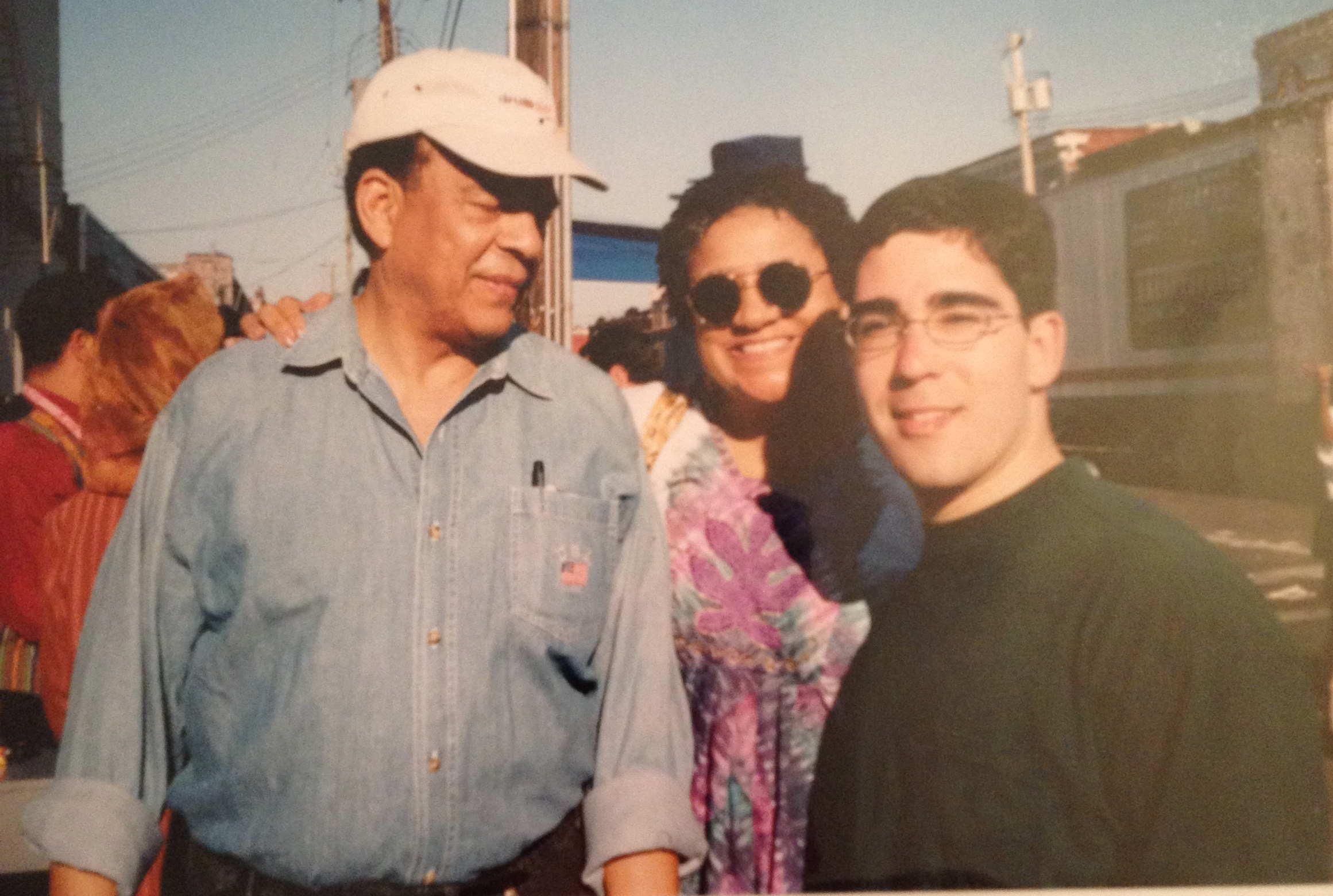
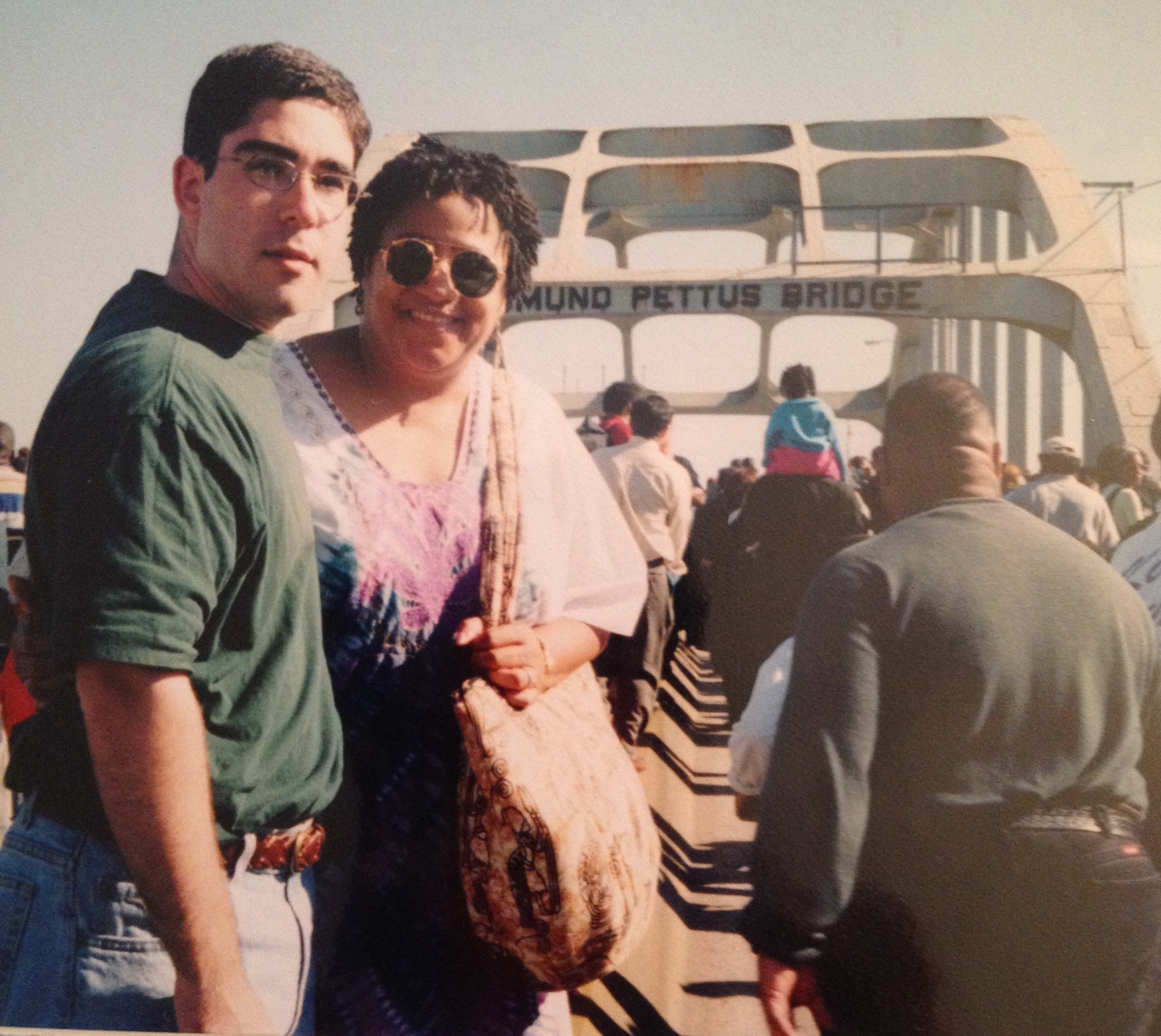
One of the things that deepens the occasion for me is that my granddaughter and I are going with one of my former students, Randy Gold, and his 8-year-old son, Natanel.  That would be good enough, but it gets even better.  Randy and I went before.  Fifteen years ago in 2000.  In fact, Randy was the one who introduced me to the event.  The year we went for the 35th anniversary, President Bill Clinton was there.  We have a photo of us with Ambassador Andrew Young, as well as a photo of us at the Edmund Pettus bridge (see below).  I love it that Randy knew me well enough to know I would be interested.  His synagogue sponsored a bus and we were on it.  What an incredible experience.

So, you can imagine what a delight it was to receive a text from him a couple of weeks ago asking if I wanted to go again this year.  In the interim, among other things, Randy has married, had three children, become the president and chairman of the board of a prestigious AGH accounting firm in Atlanta and established a foundation for the disease, ML4, that their precious daughter Eden was born with, for screening Jews for previously generally un-screened for genetic predispositions that can have adverse effects on childbearing among Jews. His foundation has been featured by Dr. Sanjay Gupta on CNN at least four times.

I met Randy, who graduated in 1994, when he took my Legal Environment of Business class years ago.  My classes always begin with relevant current events students bring in as a way of me being able to connect what they are learning to what is actually happening with these issues in the world.  This gives them a deeper appreciation of the subject matter and takes us out of them just thinking this is some dull, dry stuff in a textbook they have to learn for a test, that has no connection to real life. So, we discuss a wide range of topics before it is all said and done.

One of the reasons I remembered Randy so well was because he rarely said anything in class, but totally surprised me when at the bottom of his final exam, he had written me a note.  To this day, I don’t know why I even saw it.  I generally have no occasion to look at students’ exams because their answers are on a separate sheet of paper called a scantron and those  are graded electronically.  With all I have to do calculating grades and winding up a semester, I don’t have time to do unnecessary, extraneous things of absolutely no value.  Students do not write answers on the exam, so there is no reason for me to look at them.  But, for some reason, I did and Randy had left me a note which I can probably still put my hands on today.  In the note, he thanked me because said that he had learned so much in the class not only about the subject matter, but about life.  As an example, he said that he didn’t think he would have characterized himself as homophobic before the class, but after taking my class, he realized how stupid some of his thoughts were.  I couldn’t even recall our class conversation about this issue, but I was truly touched by his comment.  It made me realize even more the importance of what I do each and every day when I walk into a classroom.  Helping people see the world in a different, more expansive way that moves us forward as a people.

We kept in touch over the years as he crafted his life.  He was so serious about getting it right.  Though he and his brother Jeffrey, who also graduated from the University were always bunches of fun, I was always struck by Randy’s dedication to his religion and to his commitment to being a decent human being. I marveled at his involvement in his community and to causes he cared about, freely investing his time, energy and money as seriously as if it were his job.  He certainly considered it his duty.  That is so unusual for someone so young.  I listened to his escapades in his attempt to find the right fit for a job and for a wife. I was ecstatic for him when he finally found the one he believed to be the right one for both. He was right to take it so seriously, because it paid off.  He got it right.  I attended his wedding (his wife Caroline is incredible) and over the years have rejoiced at his professional climb and his growing family.  A couple of years ago he emailed me a video of his son, then 6, doing a book report on Jackie Robinson, the first black baseball player to play in the professional leagues.  He told me the teacher allowed the students to choose whatever book they wanted.  His son loved baseball and could not understand why someone who played great baseball would be prevented from playing professional ball and when he finally was able to do so, why he would have been treated so poorly by others who supposedly loved baseball.  So, his son decided to do his book report on Jackie Robinson.  His speech and drawings shown in the video were precious.  But, Randy had sent it to me, he said, because he wanted me to know that the lessons he’d learned were now being passed down to the next generation.  His sentiment brought tears to my eyes.

So, for me to be going to Selma for the 50th anniversary commemoration of the Bloody Sunday march would be significant enough.  Honoring the sacrifices of those brave souls who stood up to discrimination, oppression and injustice with their bodies so that i could have the right to vote as an African American is the very least I can do. To be going with my former student Randy again after 15 years, with his son Natanel and my granddaughter Makayla, is nothing less than absolutely and extraordinarily awesome.

My student, Ambassador Andrew Young and I at the 35-year Selma commemoration in 2000.

Randy, Ambassador Andrew Young and I at the 35-year Selma commemoration in 2000.

IMG_2548

Musings on creating a TED Talk…

01 Sunday Mar 2015

Posted by dawndba in Uncategorized

≈ Leave a comment

Tags

Narke Norton, public speaking, TED Talks, TEDx, TEDxUGA, UGA

I was introduced to TED Talks by one of my students several years ago (thanks, McCoy!).  I instantly fell in love with them and have been viewing them ever since.  You can, then, imagine how happy I was to discover last year (March 2014) that my own university had become a licensed TEDx site and was holding its second annual TEDx program (TED talks are out of New York and Canada, but TED licenses other locations to conduct TED Talks and those are called TEDx). Nirvana!  I don’t know how I managed to miss the first one, but I was certainly going to jump on that train as quickly as possible.  In order to get tickets, you have to commit to going for the entire program since it is done with an audience.  We’re talking about from something like 10-6.  I couldn’t imagine how that worked, but we were willing to try.   I went with my daughter, AnneAlexis.

We were totally blown away.  From the very first speaker, a student who spoke on the issue of the importance of debate societies, to the very last, it was simply mind-blowing.  The TED Talk tagline is “ideas worth sharing,” and each and every one of the dozen or so speakers absolutely fit that.  The ideas were incredible, the delivery of them incredible, and the overall way the audience experience was handled by the organizers was incredible.  I’ve never seen anything like it.  What seemed like an extraordinarily long time for a program, flew by.  You were so interested in the speakers until time did not matter.  We were given two breaks over the span of the event, we were fed, we played games and had time to speak to perfect strangers, it was awesome.

I recall walking away discussing the program with my daughter and saying, “I could NEVER do a TED talk!!!”  Since public speaking of one kind or another is my life, my daughter couldn’t understand why I would say that.  I told her that I was more of an extemporaneous speaker.  Though always well prepared, I bring my audience into whatever I am presenting and use their energy and ideas to give them what they came for.  They matter to me and they are an integral part of what I deliver.  I HATE the idea of simply delivering a speech.  Even when I do a keynote address for something like a graduation, I bring the audience into it.  Just standing and speaking?  No way.  Using notes or having a prepared text memorized?  Not me.

Then I was asked by the TEDx folks to allow them to nominate me to do a TEDx talk.  Wow.  Wonderful to be asked, but I declined.  “Sorry.  I don’t do that sort of speaking,” I said. “But, we’ve asked all around and your name keeps coming up!  Of course you can.  And we will support you the whole way.  You’ll have a team assigned to you whose only job is to help you make your talk conform to the TED format.”  We went back and forth about it and she finally convinced me to at least go online and fill out the nomination form before the deadline so I could be considered and I could always decline the nomination if it came.  I was so hesitant until I emailed her just before pressing the “send” button.  “Are you sure about this?, I asked.  “Push the send button,” she said.

Well, I did, and days later I received the news that I had been chosen.  Of course, once that happened, it was hard to decline.  They sent a team to interview me to make sure I would agree to do it, was available for the event and surrounding commitments, and was amenable to having a team of students help me.  The students take a class in how to do TED Talks and in addition to doing one themselves for the class, they teach presenters what they’ve learned about how this is done.  As it turns out, part of why the interview is necessary is that some people are not at all comfortable with the idea of taking instruction from students.  Well, that wasn’t a problem for me.  I teach students every day and deal with them in extracurricular activities and I know how incredibly competent and committed our students are.  Plus, they’ve had the class and I haven’t.  So I agreed.  More than giving the talk itself, I was intrigued by taking what was in my head and letting the students help me create a TED Talk that would be something that would look like—actually be— a TED Talk.  Much like when I write, I did it because I wanted to see the final product.  What would a TED Talk by me look like?  How would I actually say the idea that I had that was worth sharing?  What would the process of getting there look like?

The process has been all I could have hoped for.   I have LOVED it!!!!!!! The entire process! Today is March 1st and the program is March 27th.  The dress rehearsal is March 26. The 500 tickets were sold out within the first hour they went online.  It has created enormous buzz.  I hadn’t told my classes I was doing it, but I happened to have in my class a student I had had the semester before when I was chosen and I had told his class.  I happened to have him in class the day and time that tickets went on sale and at the end of class he came up and excitedly told me that he’d secured a ticket.  I didn’t have the heart to scold him for being online in class.  🙂  He told me I really should tell my classes.  The truth is, I really hadn’t told a lot of people about it.  Mostly, I told people as it came up in terms of dates.  That is, when we were seeking dates for meetings, I would tell them I wasn’t available because I was doing a TED Talk.  They always instantly registered awe.  Actually, it’s rather embarrassing.  I’m just giving information, but I forget how it will be taken.  But the truth is, I would have reacted the same way if someone had told me they were doing a TED Talk!

After the website was posted announcing the presenters and because of my student (thank you, George!  🙂  ), I decided to tell my classes and to put it on my Facebook page.  I was not prepared for the reaction.  The students seemed to look at me with new eyes.  My students tend to love me already, but this was different.  It was as if the idea that I could actually be asked to do a TED Talk that could be seen by the entire world made me somehow elevated to a new position in their minds.

I don’t do an awful lot on Facebook.  I tend to go on only if I receive an email notice that makes me want to congratulate someone for something or I click on “share on Facebook” if an idea regarding equality issues and civic engagement comes up.  It is rare for me to actually go on and post something.  But, I posted that I was doing a TED talk.  I was amazed at the response.  People from as far back as law school (I graduated in 1975!) left comments for me saying incredibly complimentary things.  The list of names in the comments and over 100 “likes” was like reading a review of my life.  People I had been involved with in ways large and small reached out.  We touch so many people in our lives that it is easy to forget how much of an impact we have—and it doesn’t help if you tend to slough off the thanks and just move on to the next item on the agenda.  With me being a professor, I touch even more people than most and sometimes do so at crucial times in their lives.  Seeing the names and immediately remembering them, even from decades ago, was like getting to listen in at my own funeral.   Unbelievable. Incredible. Truly, truly touching.

While that has been a part of the process I had not realized would be there, the part of the process that has been what I looked forward to —choosing a topic, honing it down and shaping it into an actual TED talk, has been amazing.  I asked lots of people what I should speak on, including my students I told when I was chosen.  I read a poem at the beginning of each class, and several suggested I do that because it was so impactful.  My 8-year-old granddaughter looked at me with a “Duh..” look and said, “Nana, you have to talk about what you ALWAYS talk about!  Love and the Law!  One of the people I asked was the president of my university.  We had been colleagues for 25 years before he was appointed and he knew me and my work, especially with students, well enough to know issues of interest to me. His suggestion was what immediately gave me my first draft of 18 pages.  Of all the things everyone had said to me, his was the one that set my mind in a swirl.  Not the topic he actually suggested, but instead, what it made me think of.  Getting out that first draft was ENORMOUSLY helpful.  If I was going to be confident about doing this, I knew I needed time.  The sooner I could nail down a topic, the longer I had to be able to think about it.  I am more of an appellate lawyer than a courtroom lawyer, though I am capable of both.  Appellate lawyers get plenty of time to think about their topic, research it, try this and that, and craft their final product.  Courtroom attorneys have to battle it out minute by minute on the spot.  I am more of the former.  I need time to think and re-think and craft my words and ideas.  I realize that I get some of my best thoughts when I am working out at the gym each morning, or walking my 10,000 steps a day, or even drifting off to sleep.  I need that time.  So, although I had not yet even had the first meeting with my team, I had a complete first draft.  When we met, they were astonished.

By the way, I am not revealing anything about my topic before I give my talk.  Of course, it is always the first thing people ask as soon as they know I am doing one.

My first timed draft in October was 22 pages and was 30 minutes long.  I was told it had to be no longer than 18.  I honed it down to that and was told the time had changed to no longer than 12 minutes.  I got there.  But, the process of doing so has been phenomenal and will stay with me forever.  Doing a TED Talk makes you have to think about the true clarity of your message.  Everything I have said in every draft is worth saying, but in the end, if I have to cut something out for time, what can go, yet still leave my message totally intact?  That clarifies my thinking in ways I am not sure I have ever done.  It is totally different than, say, preparing for a 20-minute presentation to an audience for Black History Month, as I have to do for tomorrow, or even meandering around at will as I do here in a blog.

As a textbook author whose texts are used worldwide, as a professor who speaks to classes with students from all over the world, I am used to the idea of taking my audience into account (rather than saying what it is I might want to say with no regard for how it is received) and trying to make sure my message can be understood by all, not just people “just like me.”  But, doing a TED Talk takes that to a new level.  I am used to expressing my ideas, but I generally do so in a way that is a one-shot deal.  With a TED Talk, you have to think about people all over the world watching your talk over and over.  Some things that are fine on a fly-by basis, do not stand up the same way to close examination. The good thing is that my message is a familiar one to me and is absolutely what I would tell the entire world if I had the chance.  That is comforting because it means I will not be struggling with something unfamiliar that I am trying to do just for TED Talk purposes.  My message is my life, so it is not foreign to me, and that means I don’t have to worry about spending precious energy being uncomfortable on that score.

I have pretty much left this month free to deal with my TED Talk.  Where I could, I have not scheduled things because I know that it helps me to be centered, comfortable, and laser-focused, which gives me the confidence I will need to go out onto that stage and face 500 people in the audience and potentially millions around the world.  I’m not quite sure what people who are not used to public speaking do.  That would be so daunting.  One of the speakers from last year told me she had had, I think, an operation on her Achilles tendon the week before.  I can’t imagine.  And she was drop-dead phenomenal. I tell myself that if she can do that, then certainly, I should be able to speak my truth and do it well if I am in good health and centered.   My team has been absolutely wonderful.  They know their stuff and give great helpful suggestions and insights.

Even as I say this, I continue to hone and preen and craft and massage my message so that it meets the standards of the incredible TED Talk presenters that I know and love. Speaking of which, I’d better get back to it!  🙂

By the way, our TEDx program will be live streamed on March 27.  To find out how to get it, visit the website at tedxuga.com.

UPDATE:  This is the link to my talk!:https://www.youtube.com/watch?v=ExcDNly1DbI

This is one of the photos they took.  It’s my favorite because it so captures what the whole experience was for me and how much I enjoyed it.

Me finishing up my talk.

Me finishing up my talk.

Close up of my face because that's how I feel.

Close up of my face because that’s how I feel.

Subscribe

  • Entries (RSS)
  • Comments (RSS)

Archives

  • July 2024
  • February 2024
  • May 2021
  • June 2019
  • April 2019
  • January 2019
  • December 2018
  • November 2018
  • October 2018
  • July 2018
  • May 2018
  • March 2018
  • September 2016
  • June 2015
  • May 2015
  • April 2015
  • March 2015
  • January 2015
  • December 2014
  • November 2014
  • May 2014
  • April 2014
  • March 2014

Categories

  • Election Self-Care
  • Gender Issues
  • Uncategorized

Meta

  • Create account
  • Log in

Blog at WordPress.com.

  • Subscribe Subscribed
    • Peaces of My Heart
    • Join 26 other subscribers
    • Already have a WordPress.com account? Log in now.
    • Peaces of My Heart
    • Subscribe Subscribed
    • Sign up
    • Log in
    • Report this content
    • View site in Reader
    • Manage subscriptions
    • Collapse this bar
 

Loading Comments...